
Lighting Manufacturing Quality Control: From Raw Materials to Final Product
Introduction
In lighting manufacturing, quality is often judged by the final product.
However, experienced buyers know that product reliability is determined much earlier — across the entire production process.
A structured Quality Management System ensures consistency, reduces risk, and improves long-term performance.
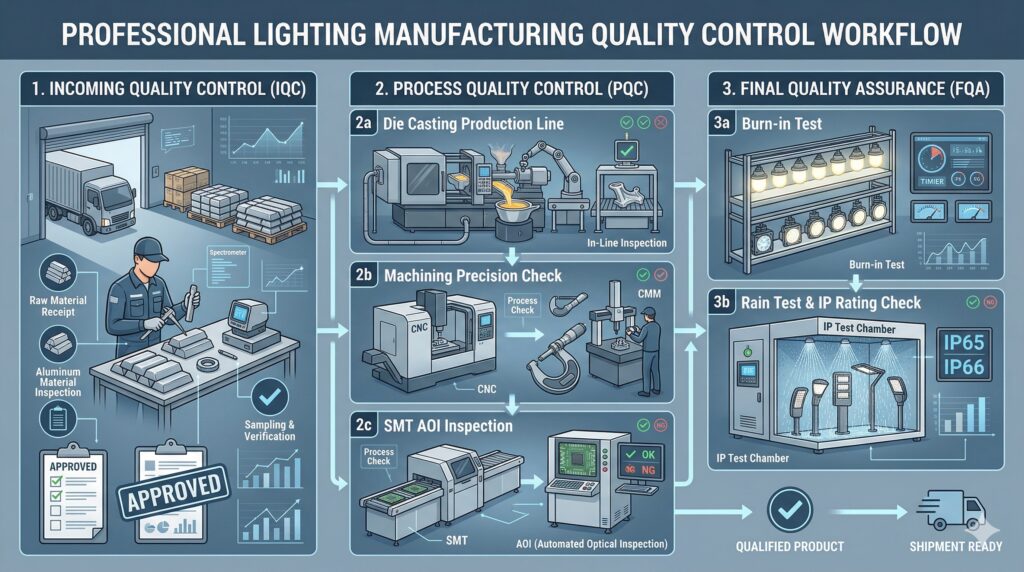
In this article, we break down how quality is controlled at three critical stages:
- Incoming Quality Control (IQC)
- Process Quality Control (PQC)
- Final Quality Assurance (FQA)
1. Incoming Quality Control (IQC)
Quality starts before production begins.
Incoming Quality Control focuses on verifying that all materials and components meet specifications before entering the production line.
Typical checks include:
- Aluminum alloy ingots tested for material composition
- Electronic components inspected before SMT production
- Packaging and sub-assembly parts verified upon arrival
Why it matters for buyers
Material consistency directly impacts:
- Structural strength
- Heat dissipation
- Product lifespan
By controlling quality at this stage, manufacturers can:
✔ Reduce defect rates early
✔ Prevent production disruptions
✔ Ensure consistent product performance
2. Process Quality Control (PQC)
Even with qualified materials, quality can still be compromised during manufacturing.
Process Quality Control ensures that each production step meets defined standards before moving forward.
Key checkpoints include:
- 100% inspection of die-cast parts after deburring
- Machining tolerance verification and thread gauge checks
- Powder coating inspection for thickness and adhesion
- SMT AOI inspection for soldering and component placement
Why it matters for buyers
Uncontrolled processes can lead to:
- Assembly issues
- Coating failures
- Reduced durability in outdoor environments
With proper PQC, buyers benefit from:
✔ Stable product quality across batches
✔ Lower defect rates
✔ Reduced risk of field failures
3. Final Quality Assurance (FQA)
The most costly quality issues often occur after installation — not during production.
Final Quality Assurance acts as the last safeguard before shipment.
Testing typically includes:
- In-line functional testing during assembly
- Hi-Pot testing for electrical safety
- 100% burn-in testing to detect early failures
- Reliability tests such as rain and thermal testing
Why it matters for buyers
Failures in the field can result in:
- Project delays
- Increased warranty costs
- Reputation risks
By validating products before shipment, manufacturers help ensure:
✔ Reliable product performance
✔ Reduced installation issues
✔ Lower long-term maintenance costs
Conclusion
Quality in lighting manufacturing is not a single checkpoint —
it is a continuous process from raw materials to final validation.
For buyers, understanding how a factory manages quality across these stages is critical when selecting the right manufacturing partner.
A well-implemented end-to-end quality management system not only improves product reliability but also reduces total project risk.


發佈留言