
DLC SSL V6.0 & LUNA V2.0: What “Control Ready” Really Means for Lighting Buyers
In the world of commercial lighting, “Control Ready” is no longer just a feature—it’s a mandatory gateway to the DLC Qualified Products List (QPL) and, consequently, to lucrative energy rebates.
With the release of DLC SSL V6.0 and LUNA V2.0, the definition of Category 1: Control Ready has become more rigid. For Product Managers and Sourcing teams, misunderstanding these nuances can lead to rejected rebate applications and unsellable inventory.
Here is the definitive guide to navigating the new “Control Ready” landscape.
What is “Control Ready”? (It’s Not Just a Hole in the Housing)
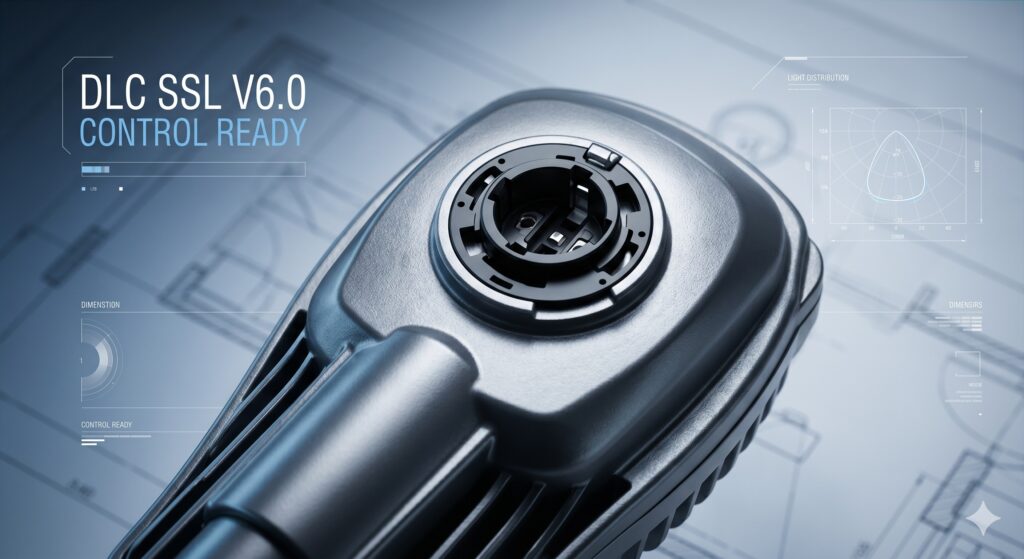
According to the DLC, a product is Control Ready (Category 1) only if it meets three specific criteria simultaneously:
- Integral Control Receptacle: The fixture must have a pre-installed socket or interface.
- Plug-and-Play Compatibility: A controller must be installable in the field without opening or modifying the fixture’s internal wiring.
- Procured Separately: The controller is NOT installed at the factory; it is a separate line item.
Key Distinction: > Control Ready $\neq$ “Provision for sensor.”
Control Ready $=$ “Standardized, plug-and-play interface for future-proofing.”
Approved Interfaces: What Qualifies?
To pass DLC inspection, your fixture must utilize standardized connectors. Common compliant interfaces include:
- Outdoor Applications: NEMA 5-pin or 7-pin Twistlock (ANSI C136.41) or Zhaga Book 18.
- Indoor Applications: Zhaga Book 20 (e.g., for Troffers and Linear lights).
- Universal Standards: USB-C (IEC compliant), 3.5mm Phono Jacks, or Z10.
Common Compliance Traps: Why Your Fixture Might Be Rejected
This is where many low-cost suppliers fail. Be vigilant about these three “Red Flags”:
1. The “Knockout” Fail
If your fixture requires a contractor to drill a hole or punch out a knockout and then wire a sensor in the field, it is NOT Control Ready.
- Consequence: Loss of DLC qualification and rebate eligibility.
2. Integral Sensor Confusion
If a sensor is pre-installed at the factory, the fixture is classified as Integral Control, not Control Ready. While still high-quality, it belongs to a different DLC category and requires different documentation.
3. The 3-Pin Twistlock Trap
The DLC has explicitly excluded 3-pin NEMA Twistlocks because they lack the dedicated pins required for dimming signals (0-10V or DALI).
The Documentation Gap: The “Spec Sheet” Audit
A product can be designed perfectly but still fail DLC review if the Spec Sheet is lacking. To remain compliant, your documentation must:
- Explicitly state the control capability.
- Link the capability directly to specific Model Numbers/Ordering Codes.
- Identify the specific standardized interface used (e.g., “7-pin NEMA receptacle included”).
Impact on Sourcing & Product Management
The shift to SSL V6.0 changes the procurement strategy in three ways:
- Risk Management: You must verify “Standards + Function + Documentation” before placing a PO.
- BOM Strategy: Control Ready fixtures offer a lower initial Bill of Materials (BOM) cost compared to Integral Control fixtures, allowing for more flexible inventory.
- Supply Chain Vetting: Your suppliers should no longer just answer “Yes, we have sensors.” They must provide the specific DLC Control Category and updated Spec Sheets.
Conclusion: The “Compliance First” Era
“Control Ready” is the new baseline for the North American market. As non-controlled luminaires become marginalized, standardized interfaces like Zhaga and NEMA will become the universal language of the industry.
Before your next shipment, ask your supplier:
- Is this SKU listed as Category 1 on the DLC QPL?
- Does the spec sheet explicitly list the interface standard?
- Is the driver 0-10V dimming-ready for plug-and-play controllers?
Need a deeper dive?
We can provide a “Control Ready vs. Integral Control” Comparison Sheet for your sales team or help you audit your current Spec Sheets for DLC SSL V6.0 compliance. Contact us today.


發佈留言