
Why Vertical Integration Matters in Lighting Manufacturing: Faster Customization & Stable Lead Times
In today’s global lighting supply chain, pricing is no longer the only deciding factor.
More OEM and ODM buyers are facing a different challenge:
👉 Suppliers that cannot adapt when conditions change.
Specification updates, compressed timelines, and last-minute engineering adjustments often lead to unexpected delays — not because of cost issues, but because of limited operational control.
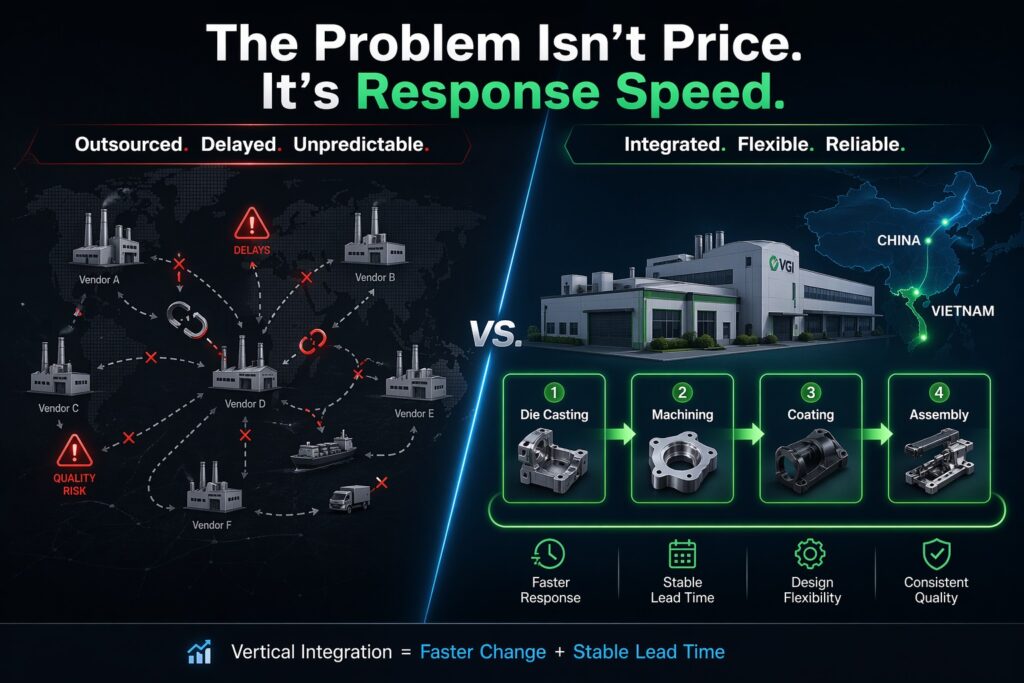
The Hidden Risk: Fragmented Supply Chains
Many lighting manufacturers rely on multiple external vendors for key processes such as:
- Die casting
- Surface treatment
- Machining
- Assembly
While this structure may appear cost-efficient, it often introduces:
- Longer communication cycles
- Increased production variability
- Delays when changes are required
In fast-moving projects, this becomes a critical bottleneck.
What Vertical Integration Actually Solves
Vertical integration is often discussed as a quality advantage — but its real impact goes further.
At its core, vertical integration enables faster response and greater flexibility.
1. Faster Customization
With in-house capabilities across die casting, machining, coating, and SMT assembly, engineering changes can be implemented immediately without waiting for third-party coordination.
2. Stable and Predictable Lead Time
By reducing dependency on external vendors, production schedules become more controllable, minimizing delays caused by supplier constraints.
3. Consistent Quality Control
From aluminum raw material verification to pretreatment, powder coating, and burn-in testing, a fully integrated process ensures tighter quality management at every stage.
The Role of Dual-Country Manufacturing
In addition to vertical integration, a dual-country manufacturing platform (Vietnam + China) provides further advantages:
- Supply chain diversification
- Risk mitigation (tariffs, geopolitical factors)
- Flexible production allocation
This combination allows manufacturers to maintain both cost competitiveness and operational stability.
Vietnam Localization and Tariff Advantage
High localization of key components in Vietnam enables compliance with Certificate of Origin (COO) requirements.
This is increasingly important for global customers seeking:
- Tariff optimization
- Long-term supply chain reliability
- Reduced dependency on single-country sourcing
Beyond Capability: The Real Competitive Edge
Vertical integration is not just about having more processes in-house.
It fundamentally changes how a manufacturer responds to change.
👉 Instead of coordinating across multiple suppliers,
👉 adjustments can be made immediately within a controlled system.
For OEM and ODM customers, this translates into:
- Faster development cycles
- Greater customization flexibility
- More reliable delivery timelines
Conclusion
As the lighting industry continues to evolve, the ability to respond quickly and consistently is becoming more valuable than cost alone.
Vertical integration, combined with a dual-country manufacturing strategy, offers a practical solution to modern supply chain challenges — delivering both flexibility and stability in an increasingly uncertain environment.


發佈留言