
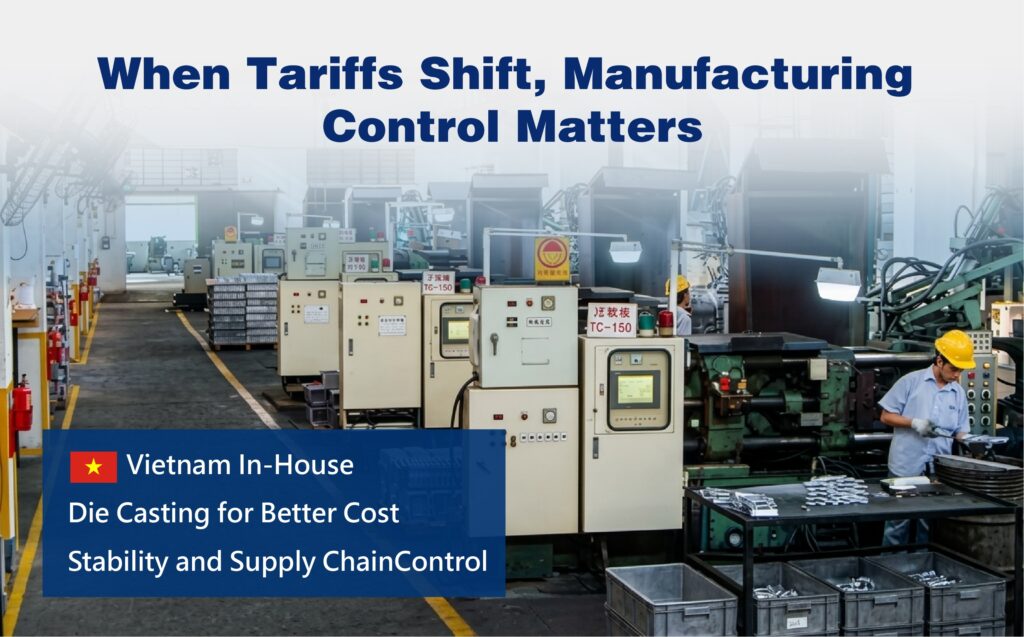
Why In-House Die Casting in Vietnam Matters for Outdoor Lighting Buyers
In today’s lighting industry, buyers are facing a different kind of sourcing challenge.
It is no longer enough to compare suppliers based only on unit price, lead time, or country of origin. As tariffs, supply chain risk, and product cost structures continue to shift, more buyers are asking a more important question:
How much of the product is actually under control?
For outdoor lighting programs, this question matters more than ever.
Products such as wall packs, flood lights, vapor tight fixtures, canopy lights, area lights, and decorative outdoor luminaires often depend heavily on aluminum die-cast housings and metal structural components. These parts are not only important for product performance, but also for cost, quality, engineering flexibility, and manufacturing stability.
That is why in-house die casting in Vietnam is becoming increasingly valuable for OEM and ODM lighting buyers.
In-House Die Casting Is About More Than Where the Part Is Made
When buyers hear “Vietnam manufacturing,” many first think about diversification and tariff strategy.
That is certainly part of the value. But the real advantage of Vietnam-based die casting for lighting products is not just location. It is control.
In-house die casting gives a manufacturer stronger control over one of the most important structural elements in outdoor lighting:
- aluminum housings
- heat sinks
- brackets and mounting parts
- structural enclosures
- mechanical support components
These parts often carry a significant portion of the material and manufacturing cost in outdoor lighting fixtures. If a buyer needs to optimize cost, improve assembly, or adjust the product structure, these components are usually where the changes begin.
A supplier that controls die casting internally can often respond faster and more effectively than a supplier relying on multiple outside vendors.
Why This Matters to Buyers and Product Managers
For buyers and product managers, the real concern is not simply whether a supplier can manufacture a product.
The real question is:
Can that supplier help manage change?
That change may come from:
- tariff shifts
- material cost increases
- product cost reduction targets
- design revisions
- new customer requirements
- lead time pressure
- assembly or quality issues
When key metal parts are produced through an in-house die casting operation, there is often much more flexibility to respond.
This can create practical advantages such as:
- better cost visibility
- faster engineering response
- more efficient product revisions
- stronger quality consistency
- improved manufacturing coordination
In other words, the value is not just in producing a housing.
The value is in helping buyers build a product that is easier to control over time.
Why Secondary Operations Matter After Die Casting
One important detail that buyers often overlook is this:
A die-cast part is usually not the final ready-to-assemble part.
After die casting, many outdoor lighting components still require secondary operations, such as:
- CNC machining
- drilling and tapping
- trimming and deburring
- thread creation
- surface preparation
- sealing surface finishing
- dimensional corrections
These steps are critical because they affect whether the part will actually perform correctly in production.
For example, these operations influence:
- mounting hole accuracy
- LED board fit
- driver mounting alignment
- gasket sealing performance
- waterproof assembly integrity
- screw thread quality
- overall fixture assembly consistency
This is especially important in outdoor LED lighting manufacturing, where fit, sealing, and structural stability are essential to product reliability.
That is why die casting alone is not the full story.
**Die casting creates the shape.
Secondary operations create the performance, fit, and manufacturability.**
The Advantage of Better Manufacturing Integration
When die casting, secondary processing, and final assembly are better connected, the entire product development and production cycle becomes more manageable.
For buyers, this can mean:
1. Faster Product Adjustments
If a product needs to be modified for cost reduction, installation requirements, or customer feedback, structural changes can often be handled more efficiently.
2. Better Cost Optimization
If a housing design or metal content needs to be optimized, the manufacturer can often react earlier and more strategically.
3. Better Production Stability
Fewer disconnected handoffs across multiple outside vendors can help reduce delays, inconsistency, and quality variation.
4. Better Engineering-to-Production Alignment
When manufacturing teams have closer control over critical structural components, it is easier to improve manufacturability and reduce downstream issues.
For OEM and ODM buyers, this kind of integration can reduce risk in ways that are not always visible in the initial quotation.
Why Vietnam Is Becoming More Important for Lighting Manufacturing
Vietnam continues to gain attention as a strategic manufacturing base for outdoor lighting OEM and ODM programs.
However, not all Vietnam manufacturing offers the same value.
There is a significant difference between:
- simple final assembly in Vietnam
and - a manufacturing partner with real in-house capability
That difference matters when buyers need:
- more control over product structure
- faster engineering changes
- better cost optimization
- more supply chain resilience
- more confidence in long-term production planning
This is why Vietnam lighting manufacturers with in-house die casting capability are becoming more relevant to sourcing teams looking beyond short-term pricing.
What Buyers Should Really Look For
When evaluating a lighting manufacturing partner, buyers should look beyond the finished fixture and ask:
- How much of the metal structure is under direct control?
- How quickly can the supplier support product changes?
- How well are die casting, machining, and assembly coordinated?
- How much supply chain risk is hidden behind the quotation?
- How stable will this product be over time?
These questions often reveal more about long-term sourcing value than price alone.
Final Thought
In today’s market, customers are not only buying a lighting fixture.
They are buying the supplier’s ability to manage:
- structure
- cost
- timing
- quality
- change
That is why in-house die casting in Vietnam matters.
Not simply because it changes where a product is made —
but because it improves how the product is controlled.
For outdoor lighting buyers, that difference can be meaningful.
If your team is reviewing sourcing options for outdoor lighting products, working with a manufacturer that offers stronger control over structural metal components can make a meaningful difference in cost, flexibility, and long-term production stability.
To learn more about Caster Lighting’s Vietnam-based manufacturing capabilities, feel free to contact our team.


發佈留言