
Why More Lighting Buyers Are Moving Production to Vietnam in 2026
Why More Lighting Buyers Are Moving Production to Vietnam in 2026
For years, Vietnam was viewed primarily as a backup sourcing option for lighting manufacturers.
In 2026, that perception has changed.
For many OEM and ODM lighting buyers, Vietnam is no longer contingency capacity—it is becoming a core part of sourcing strategy.
The shift is being driven by more than labor cost. Tariffs, supply chain flexibility, IP protection, and manufacturing maturity are all reshaping how buyers evaluate production locations.
Here’s why more lighting programs are moving to Vietnam.
Tariff Differences Are Reshaping Landed Cost Strategy
One of the biggest drivers behind Vietnam sourcing is the growing tariff gap between China and Vietnam.
For many lighting products imported into the United States:
- Vietnam-origin imports: approximately 21% tariff
- China-origin imports: approximately 46% tariff
While exact duty impact varies by product classification and trade policy, the gap can significantly affect landed cost.
For OEM buyers managing large-volume programs, this often translates to:
- Improved gross margin
- Better pricing competitiveness
- Greater room for channel promotions
- Reduced pricing pressure from distributors
As tariffs continue to influence sourcing decisions, many buyers are reevaluating whether a China-only strategy still makes financial sense.
Vietnam Is No Longer Just “Backup Capacity”
Historically, some buyers viewed Vietnam as suitable only for basic assembly or overflow production.
That is no longer the case.
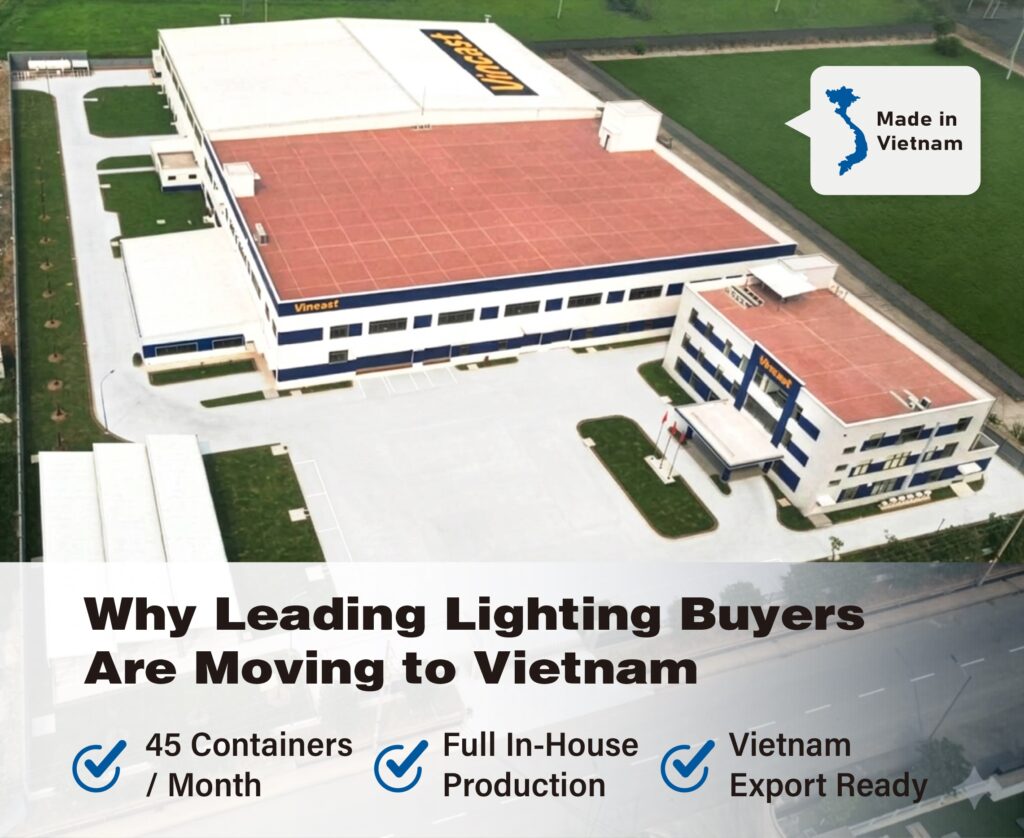
Vietnam’s manufacturing ecosystem has matured significantly, with more suppliers offering:
- In-house die-casting
- Powder coating / finishing
- SMT and electronics assembly
- Final fixture assembly
- Tooling development and ODM support
This vertical integration allows buyers to source complex lighting products from Vietnam without sacrificing process control or product consistency.
Why Lighting OEM Buyers Specifically Benefit
Lighting products present unique sourcing challenges compared to simpler consumer goods.
Many outdoor and commercial fixtures require:
- Precision die-cast housings
- Thermal management expertise
- Secondary machining
- Coating durability
- Complex electronics integration
- Regulatory compliance familiarity
Vietnam suppliers with integrated lighting manufacturing capabilities can provide significant advantages in these areas.
For buyers, this means:
- Faster development timelines
- Better quality consistency
- Fewer supplier handoffs
- Reduced defect risk across multiple processes
Supply Chain Diversification Is Becoming Standard Practice
Many buyers are no longer looking to replace China entirely.
Instead, they are adopting a China + Vietnam sourcing strategy.
This approach allows companies to:
- Split production across countries
- Diversify geopolitical and tariff risk
- Create backup production paths
- Shift SKUs strategically based on cost structure
For lighting programs with long product life cycles, this flexibility has become increasingly valuable.
IP Protection Matters More for ODM Programs
For ODM and semi-custom lighting projects, tooling security is often overlooked during supplier selection.
However, buyers developing proprietary housings or differentiated product designs should carefully evaluate:
- Who owns the tooling
- Where tooling is stored
- Whether die-casting is subcontracted
- How design confidentiality is maintained
Suppliers with in-house die-casting and tooling control offer better protection against design leakage and unauthorized production.
This is especially important for brands competing in crowded commercial and outdoor lighting markets.
What Buyers Should Evaluate Before Moving Lighting Production to Vietnam
Not all Vietnam manufacturers offer the same capabilities.
Before shifting a lighting program, buyers should assess:
Manufacturing Scope
- Is production vertically integrated or heavily outsourced?
Capacity
- Can the supplier support scale-up beyond pilot orders?
Tooling Control
- Is die-casting performed in-house?
Export Readiness
- Does the supplier have established export/logistics processes?
Engineering Support
- Can the team support DFM / ODM modifications?
Vietnam sourcing can deliver strong benefits—but supplier capability remains the deciding factor.
Vietnam Is Becoming a Strategic Lighting Manufacturing Hub
The lighting industry’s move toward Vietnam is no longer driven by simple labor arbitrage.
It reflects a broader shift in sourcing priorities:
- Margin protection
- Risk diversification
- Product control
- Operational flexibility
For many lighting OEM and ODM buyers, Vietnam is no longer “Plan B.”
It is becoming a strategic manufacturing base for future growth.
If your team is evaluating Vietnam for upcoming lighting programs, choosing the right manufacturing partner is critical.
Look beyond country of origin—evaluate process control, vertical integration, and long-term operational capability.


發佈留言